Agriculture has always been about balancing hard work with limited resources. For centuries, farmers relied on their skills, intuition, and traditional tools to plant, water, and harvest crops. While these methods built the foundation of modern food production, they are increasingly limited in today’s world of larger farms, higher costs, and growing demand for sustainability. This is where smart agriculture comes in.
By using technologies like GNSS positioning, auto steering, land leveling, and digital management platforms, farmers can achieve centimeter-level precision that was once unimaginable. To see the difference clearly, let’s look at five essential aspects of farming—planting, fertilization, land preparation, management, and positioning—comparing traditional practices with smart agriculture solutions.
Planting Rows: Eye Estimation vs. Auto Steering
In traditional farming, planting relies heavily on the farmer’s eyesight and steady hands to keep machinery on track. Over hundreds of hectares, even the most skilled operator will create overlaps or leave gaps. This often wastes 5–10% of seeds and results in uneven crop stands that reduce yield potential.
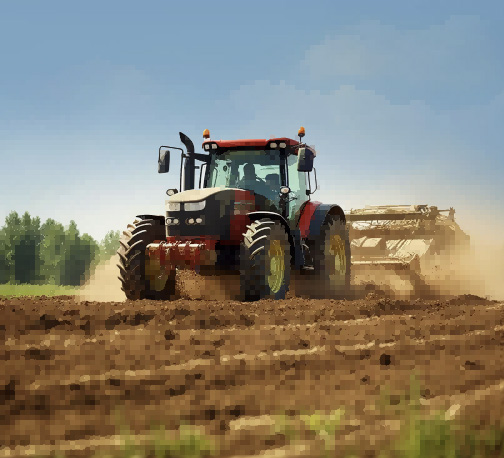
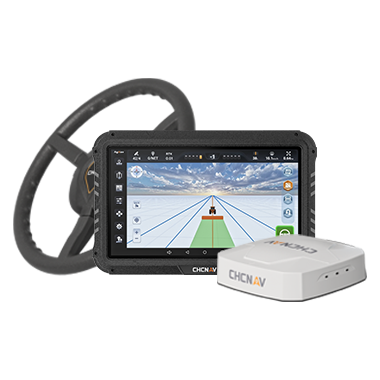
By contrast, smart agriculture equips tractors with auto steering systems such as CHCNAV NX510 SE or NX612. NX612 use GNSS RTK corrections to guide machinery with ±2.5 cm accuracy. Every row is perfectly parallel, eliminating waste and maximizing usable land. Farmers not only save on seeds but also achieve more uniform plant growth, which directly translates into higher yields.
Take the example of a corn grower. With traditional methods, inconsistent row spacing can cause plants to compete for sunlight and nutrients. With smart agriculture auto steering, rows remain consistent across the entire field, ensuring healthier, more productive crops.
Fertilizer & Spraying: Broad Coverage vs. Targeted Precision
Fertilization and crop protection are critical to success, but they are also expensive. Traditionally, farmers apply fertilizer and pesticides by covering large areas as evenly as possible. The problem is that without precision, some areas get too much while others get too little. This wastes inputs, raises costs, and increases environmental risks.
With smart agriculture, even smaller farms can improve accuracy by starting with manual guidance systems like the Guide 10. This system displays on-screen paths to help operators reduce overlaps and gaps. For those ready to upgrade, auto steering solutions like the CHCNAV X10 or NX510 Pro ensure that fertilizer and sprays are delivered with pinpoint precision. The result is less waste, healthier plants, and lower overall costs.
A real-world example: A farmer spraying fertilizer on a 200-hectare wheat field using traditional methods might overspray by 5%. With smart agriculture, that waste is eliminated, saving thousands of dollars per season while also reducing chemical runoff into nearby water sources.
Land Preparation: Uneven Ground vs. GNSS-Guided Leveling
One of the most overlooked challenges in farming is land leveling. Uneven fields cause water to pool in low areas and run off from higher ground, leading to poor irrigation and inconsistent yields. Traditionally, farmers level land by eye or with basic equipment, which is slow and inaccurate.
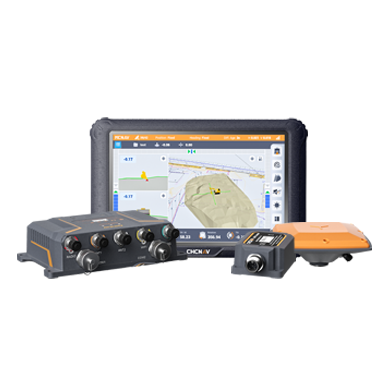
Smart agriculture changes this with the IC100 land leveling system, which uses GNSS positioning to control scrapers and blades automatically. It achieves ±2 cm leveling accuracy, creating fields that are perfectly flat or graded to the desired slope.
Farm Management: Paper Records vs. Digital Platforms
Traditional farm management often depends on paper notebooks and phone calls. Tracking multiple tractors, monitoring field progress, and assigning tasks is slow and prone to error. On large farms, this becomes nearly impossible to manage efficiently.
Smart agriculture offers a digital alternative. Platforms such as FarmMaster allow managers to assign tasks from a smartphone or computer, monitor equipment in real time, and receive automatic reports when jobs are completed. Data is stored digitally, making it easy to analyze trends and optimize future operations.
For example, instead of wondering whether a tractor has finished spraying a field, a farm manager can check FarmMaster to see progress in real time. This saves time, reduces miscommunication, and improves overall efficiency.
Positioning Accuracy: Guesswork vs. GNSS Corrections
Perhaps the most fundamental difference between traditional and smart agriculture is positioning accuracy. Farmers used to mark boundaries and rows manually, with errors measured in tens of centimeters. Over time, these small inaccuracies accumulate into significant losses.
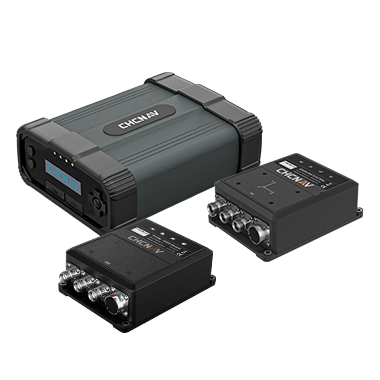
Smart agriculture solves this with GNSS base stations like the iBase AG and P5 reference station. These tools provide centimeter-level corrections across entire farms. Even in areas without reliable internet, base stations ensure that auto steering systems maintain accuracy day after day.
Large farms often deploy their own iBase AG for local coverage, while regional networks rely on P5 reference stations to support multiple users. The result is consistent precision, no matter the scale of operation.
Conclusion: Side-by-Side, the Future Is Clear
When we compare traditional farming to smart agriculture, the difference is striking. Traditional methods rely on skill and intuition but are limited by human error, inefficiency, and difficulty scaling. Smart agriculture, on the other hand, leverages advanced tools—auto steering systems like the NX510 SE and NX612, manual guidance like Guide 10, land leveling with the IC100, and GNSS stations like iBase AG and P5—to deliver precision, efficiency, and sustainability.
The benefits go beyond straighter rows or reduced costs. Smart agriculture helps farmers conserve resources, protect the environment, and make data-driven decisions that increase long-term profitability. In an era of rising input costs and growing global food demand, one thing is clear: smart agriculture isn’t just the future—it’s the present. Farmers who embrace these tools today will be the ones leading the industry tomorrow.
____
About CHC Navigation
CHC Navigation (CHCNAV) develops advanced mapping, navigation and positioning solutions designed
to increase productivity and efficiency. Serving industries such as geospatial, agriculture,
construction and autonomy, CHCNAV delivers innovative technologies that empower professionals
and drive industry advancement. With a global presence spanning over 140 countries and a team
of more than 2,000 professionals, CHC Navigation is recognized as a leader in the geospatial
industry and beyond. For more information about CHC Navigation [Huace:300627.SZ],
please visit: www.chcnav.com.