CHC Navigation offers advanced GPS/GNSS machine control systems for excavators, dozers, graders, and compactors. Improve accuracy, cut costs, and complete construction projects faster with reliable global support.
One Terminal, Unlimited Possibilities: The ISOBUS Advantage in Farming
2026-03-25
Step into the cab of a modern tractor. What do you see?
For many farmers, it is not just open fields. It is a dashboard cluttered with screens, joysticks, and cables. Each display, one for the seeder, another for the sprayer, another for the baler, speaks its own digital language. It creates a technological Tower of Babel inside the cab.
For years, this fragmentation was unavoidable. Buying equipment from one brand often locked users into proprietary control systems. But what if there were a universal language? One system allowing tractors, implements, and control terminals to communicate seamlessly, no matter the brand?
That system exists. It is called ISOBUS.
At CHCNAV, we believe technology should empower, not complicate. Understanding ISOBUS is the first step toward a simpler and more productive future for agriculture.
The Problem Before ISOBUS
Prior to ISOBUS, fragmented systems hindered efficiency and increased complexity. Key challenges included:
Clutter and confusion: Cabs crowded with screens distract operators and complicate monitoring.
Training overhead: Every terminal had a different interface. Training was time-consuming.
Lack of integration: Data could not be shared easily across implements or with the tractor’s systems.
Limited flexibility: Swapping implements meant rewiring and adjusting multiple components, which was a waste of time.
ISOBUS: The Universal Language of Agriculture
Recognizing the need for standardization, the agricultural industry collaborated to develop ISOBUS. Formally known as ISO 11783, ISOBUS is an international standard that defines communication protocols for agricultural machinery. Think of it as a plug-and-play system for farm equipment.
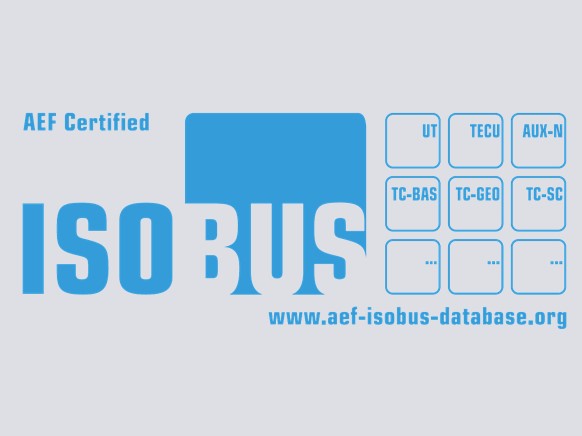
The system is currently managed by the Agricultural Industry Electronics Foundation (AEF), which provides optional certification for compatible equipment.
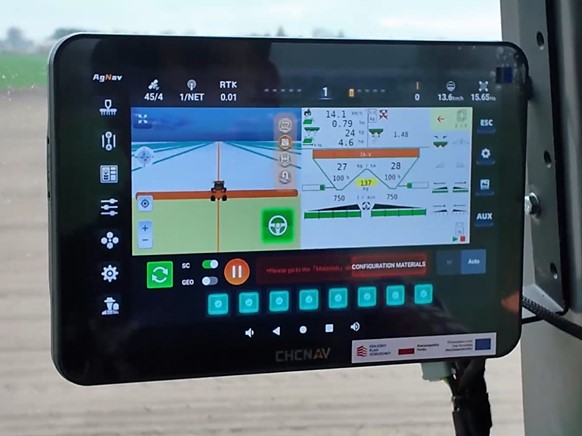
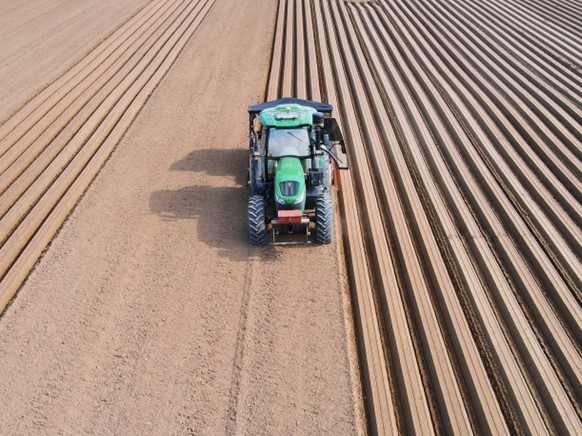
Left: CHCNAV NX series guidance display. Right: tractor equipped with the NX510.
At its core is the Virtual Terminal (VT) concept. An ISOBUS-compatible display, typically in the tractor or auto-steering system, serves as a universal terminal. When an ISOBUS-compatible implement is connected, it tells the VT what controls and information need to be displayed. The VT then generates the appropriate interface on the screen, allowing farmers to control the implement using that single display.
Task Controller Functionality
Overview of key ISOBUS components and their roles in enabling communication, control, and data exchange across agricultural machinery.
Component
Function
Features
Tractor ECU (TECU)
The "brain" of the tractor on the lSOBUS network.
Broadcasts tractor data like ground speed, PTO speed, and hitch position onto the network for the implement to use.
Provides essential tractor status information to the entire network.
Virtual Terminal (VT)
Interface for display and control.
Universal operator interface with touchscreen capability.
Task Controller (TC)
Manages and documents tasks. Handles data logging and enables precision agriculture functions based on field position (GPS).
Handles work records, prescriptions, and
section control.
Implement ECU (IECU)
Controls and monitors implement-specific functions.
Implements can have multiple lECUs, modular control.
Auxiliary Control (AUX-N)
Enables use of additional input devices (for example, joysticks).
Shortcut keys, ergonomic operation support.
Breakdown of ISOBUS task controller functions, showing how features like section control and variable rate application improve efficiency and reduce input waste.
Functionality
Full Name/ Stands For
Core Function
Simplified Key Features
Primary Benefit
TC-BAS
Task Controller - Basic
Documents task totals and
provides simple data logging.
- Logs task totals (e.g., total area, total product).
- Not location-specific.
Simple Documentation: Provides proof of work and basic records.
TC-GEO
Task Controller – Geography - based
Enables location-based data logging and the use of prescription maps.
- Uses GPS to log data with location.
- Reads prescription maps to enable. Variable Rate Control.
Automatically switches implement sections on and off to avoid overlaps and gaps.
- Uses GPS to automatically switch implement sections on/off.
- Prevents overlaps and gaps.
Input Savings: Reduces waste of seed, fertilizer, and chemicals.
VRC
Variable Rate Control
Automatically adjusts the application rate of an implement based on a prescription map.
- Adjusts application rate on-the-go based on a map.
- Requires TC-GEO and a VRC-capable implement.
Optimized Inputs: Applies the exact amount of product needed everywhere.
Beyond a Tidy Cab: Real-World Benefits for Farmers
Freedom and flexibility: Farmers can select the tractor and implements best suited for each job without worrying about compatibility. This is especially valuable for large farms with mixed-brand fleets.
Hardware cost savings: New implements no longer require expensive dedicated control terminals. One ISOBUS terminal works across an entire fleet.
Precision and efficiency: ISOBUS enables advanced precision farming functions such as TC-GEO and TC-SC. Combined with auto-steering systems like CHCNAV’s NX510, farmers can optimize input usage, reduce waste, and improve yields.
Simplified data management: With a unified system, operational data (seeding rates, application maps, yield data) is consolidated, providing clearer insights and easier analysis.
Why CHCNAV Auto-Steering is a Great Choice
Modernize any fleet: CHCNAV NX612 and NX510 systems work with front-wheel steering, rear-wheel steering, articulated tractors, tracked machines, rice transplanters, and self-propelled sprayers. Even older vehicles can be retrofitted.
All-in-one terminal: NX612/510 integrates auto-steering, ISOBUS control, and Farm Master software. A 360° panoramic and bird’s-eye view further enhances operator safety.
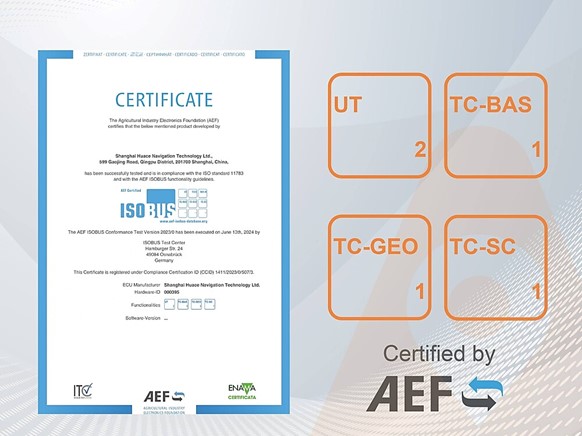
AEF certification: NX510 is AEF-certified for ISOBUS UT, TC-BAS, TC-GEO, and TC-SC.
Standards and Open Formats: Powering Interoperability in Precision Agriculture
Interoperability is not just about tractors and implements. Across the farming industry, open standards ensure that tools, data, and technologies can work together. Just as ISOBUS simplifies machine compatibility, open standards in GNSS positioning and geospatial data enable seamless precision farming across platforms.
NTRIP and RTCM GNSS Correction Standards: In precision agriculture, achieving centimeter-level GNSS accuracy requires correction data from a reference base station. NTRIP (Networked Transport of RTCM via Internet Protocol) streams corrections over mobile networks (3G, 4G, 5G). The corrections use RTCM (Radio Technical Commission for Maritime Services) message formats, an international standard. NTRIP and RTCM allow cross-brand GNSS compatibility, preventing vendor lock-in and allowing for flexible positioning solutions.
UHF Radio, The Proven Alternative for Remote Fields: For farms without reliable mobile networks, UHF radio is a proven alternative. Operating in the 410-470 MHz band, UHF radios transmit RTCM-formatted messages in transparent mode without modifying the data ensuring compatibility between different brands of GNSS receivers and base stations.
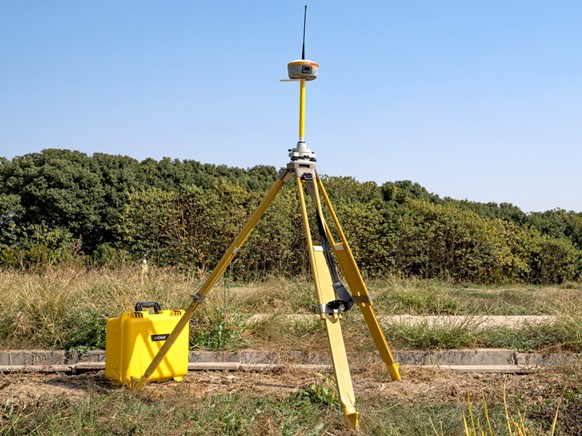
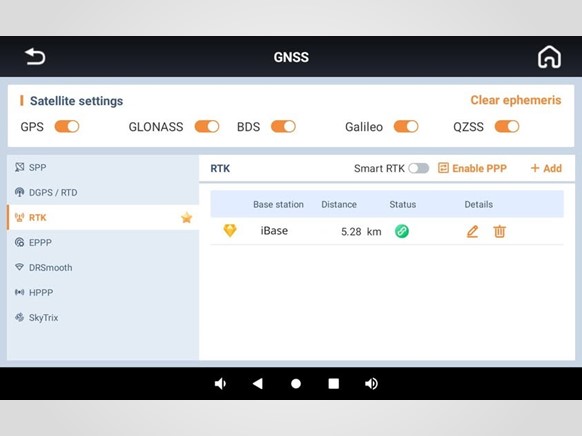
Left: iBase GNSS base station in field. Right: guidance software connected to GNSS base station.
Standardized data formats facilitate the use of geospatial information, whether from drone surveys or earthworks, enabling a wider range of applications for smarter agriculture.
LAS: The global standard for LiDAR point clouds (.las / .laz). Enables cross-platform processing for terrain mapping, canopy analysis, and more. The information provided by airborne LiDAR can be used to improve field drainage, erosion control and targeted land preparation.
DWG: In earthworks, irrigation trenching, and site grading for agricultural land. The DWG (.dwg) format is one of the most used formats for exchanging design files between engineering software and machine control systems. The DWG format captures design data in 2D and 3D and is supported by excavators, land leveling systems and other earthmoving equipment used in precision agriculture.
Open Standards Power Smarter, More Profitable Farming
In today’s precision agriculture landscape, seamless integration is essential for competitive success. ISOBUS has transformed machine interoperability, while open geospatial formats such as LAS and DWG enable cross-platform data use. Meanwhile, communication standards such as UHF transparent transmission ensure precise GNSS corrections, even in remote fields. Together, these open standards form the backbone of a smart agricultural ecosystem where machines, data, and connectivity work in harmony, empowering flexibility, choice, and innovation.
They reduce costs by preventing vendor lock-in.
They allow seamless integration of mixed-brand fleets.
They future-proof technology investments across generations.
For farmers and geospatial professionals, open standards ensure that tools can evolve, integrate, and deliver value across diverse technologies and generations. By adopting CHCNAV auto-steering solutions and embracing interoperable technologies, farmers can achieve greater precision and profitability, and lead the way toward the next generation of smart farming.
____
About CHC Navigation
CHC Navigation (CHCNAV) develops advanced mapping, navigation, and positioning solutions designed to increase productivity and efficiency. Serving industries such as geospatial, agriculture, machine control and autonomy, CHCNAV delivers innovative technologies that empower professionals and drive industry advancement. With a global presence spanning over 140 countries and a team of more than 2,200 professionals, CHC Navigation is recognized as a leader in the geospatial industry and beyond. For more information about CHC Navigation [Huace:300627.SZ], please visit: https://www.chcnav.com/about/overview
Need a complete precision agriculture solution?
CHCNAV offers integrated systems, from auto-steering to high-precision positioning, helping farmers improve efficiency and productivity.